- Do More Newsletter
- Posts
- Do More Newsletter
Do More Newsletter
This issue contains featured article "Anthropic's Fable 5-The Model That Vanished" and exciting new product information about Canva Adds AI-Powered Interactive Design Experiences, Yahoo Scout Brings AI-Powered Research to Investors and Sports Fans, Wix Brings More AI Automation to Website Creation, Adoble AI Assistant, and Shopify Magic.
In partnership with

Keep up to date on the latest products, workflows, apps and models so that you can excel at your work. Curated by Duet.

Stay ahead with the most recent breakthroughs—here’s what’s new and making waves in AI-powered productivity:
Canva continues expanding beyond graphic design with new AI-powered capabilities that allow users to create interactive experiences, presentations, and marketing assets with significantly less manual work. The company's latest updates focus on helping users generate content, layouts, and visual elements from simple prompts.
For creators and small businesses, the appeal is speed. Instead of starting with a blank page, users can quickly produce polished marketing materials, social content, presentations, and business documents. As AI-generated content becomes more common, Canva is positioning itself as a platform where users can go from idea to finished project in minutes rather than hours.
Yahoo has launched new AI-powered experiences built on its Scout answer engine for both Yahoo Finance and Yahoo Sports. Instead of opening dozens of browser tabs, users can ask questions and receive synthesized insights directly within the products they already use.
For everyday consumers, this means faster stock research and easier access to sports analysis. The launch demonstrates how AI is increasingly moving from standalone chatbots into the applications people already rely on every day.
Wix has expanded its AI-powered website creation tools, helping users generate site layouts, content, images, and business information with fewer manual steps. The company continues focusing on reducing the technical knowledge required to launch a professional website.
For entrepreneurs and small businesses, this lowers the barrier to establishing an online presence. Rather than hiring designers or developers, users can generate and customize websites through guided AI-assisted workflows.
Adobe recently rolled out a major expansion to its AI-powered creative workflow inside Photoshop and Premiere, introducing a new AI Assistant that can execute multi-step editing tasks through simple natural language prompts. The update, now available in public beta, allows users to do things like reorganize layers, rename assets, sync multi-camera footage, and even generate structured edits such as captions, markers, and background swaps without manually navigating complex menus. Adobe is also pushing deeper automation through its Creative Agent direction, which connects its tools with models like Gemini to make editing more conversational and cross-platform.
It significantly reduces the friction of repetitive production work that normally slows down creative output. Instead of spending time on mechanical editing tasks, creators can stay focused on storytelling, design, and iteration speed. For marketers, designers, and content teams, this shift turns Photoshop and Premiere into more of an AI co-pilot than a traditional software suite—making it especially valuable for anyone producing high volumes of visual content under tight deadlines.
Shopify recently expanded its built-in AI toolkit for merchants with a major upgrade to Shopify Magic, introducing more automated storefront content creation and smarter product merchandising tools. The update includes improved AI-generated product descriptions, email marketing copy, and a new set of “AI storefront assistants” that help merchants quickly build landing pages, optimize product listings, and generate promotional content directly inside the Shopify dashboard. Shopify is also pushing deeper personalization features that tailor storefront content based on shopper behavior, helping smaller stores compete with larger retailers without needing dedicated marketing teams.
For small business owners, the appeal is speed and consistency. Writing product descriptions, launching campaigns, and testing different storefront messaging usually takes hours or even days—especially for solo founders or small teams. With these AI tools, merchants can generate high-quality, on-brand content in seconds and iterate quickly based on performance. That means faster product launches, more frequent promotions, and better-optimized storefronts without hiring copywriters or marketers, making it especially valuable for lean e-commerce operations trying to grow revenue efficiently.

Creating professional voiceovers traditionally required expensive microphones, recording environments, editing software, and often a skilled narrator. ElevenLabs simplifes that process through AI-generated speech that sounds increasingly natural and expressive. The company's latest updates focus on improving emotional delivery, conversational flow, and overall realism.
One of the most important benefits of the new capabilities is that creators can generate audio that feels less robotic and more human. This makes AI-generated narration more suitable for podcasts, YouTube videos, training materials, marketing content, and educational resources where listener engagement is critical.
The technology also gives small businesses and independent creators access to production capabilities that were previously out of reach. A company can create product demonstrations, onboarding content, or promotional videos without hiring voice talent or investing in professional recording equipment.
As demand for video and audio content continues to grow, AI tools are helping creators scale their content production while maintaining quality. AI voice generation is moving beyond novelty and becoming a practical tool for everyday content creation.
The Model That Vanished

Imagine waking up to find your smartest coworker has been deported overnight.
Not fired. Not on vacation. Just — gone. Yesterday they were doing your hardest work. Today their desk is empty, and nobody will tell you exactly when, or if, they’re coming back.
That’s roughly what happened this month to the people who’d started leaning on a brand-new AI called Fable 5. And the story is worth your five minutes even if you’ve never heard of it, because it’s really a story about something you do rely on: tools you don’t actually own.
What happened, in plain English
A couple of weeks ago, Anthropic — the company behind Claude — released the most powerful AI it had ever made available to regular people. They named it Fable 5. By the company’s own tests it outscored the previous best models from Anthropic, OpenAI, and Google. It was especially good at the long, fiddly, multi-step jobs people actually struggle with.
Three days later, it was switched off. For everyone.
Not because it broke. Not because the company changed its mind. The U.S. government issued an order restricting who’s allowed to use frontier AI of this caliber — specifically, it couldn’t be made available to foreign nationals. And here’s the catch that made it an all-or-nothing situation: when millions of people share the same online tool, a company can’t reliably check the passport of every single user in real time. So the only way to comply with “some people can’t use this” turned out to be nobody uses this. A global off-switch.
As far as anyone can tell, it’s the first time the U.S. government has reached in and pulled a publicly running AI model off the table like this.
What set it off? Reports say researchers at Amazon found a way to trick the model into coughing up information it was supposed to keep locked down, and word reached Washington fast — reportedly with a nudge from Amazon’s CEO, whose company is one of Anthropic’s biggest backers. (The two sides don’t even agree on how serious it was: officials treated it as a national-security concern; Anthropic said the flaw was minor and already known.) The call, in other words, came from inside the house. But for you and me, the details matter less than the shape of it: a security worry, a few phone calls, and a tool millions of people were using was dark by Friday.
Why this is different from the usual churn
If you’ve used these tools for a while, you’re used to them changing. A new version drops, an old one gets retired, your favorite quirk disappears. I’ve written before about that upgrade treadmill — the slightly exhausting sense that the ground keeps shifting under you.
But this was a different kind of shift. The treadmill is the company deciding what you get. This was someone above the company deciding. The people who built Fable 5 didn’t want it gone. They were reportedly scrambling to bring it back. It didn’t matter. The decision wasn’t theirs, and it certainly wasn’t yours.
That’s the part worth sitting with. When you fold one of these tools into your day — your writing, your spreadsheets, your inbox, your side hustle — you’re quietly assuming it’ll be there tomorrow. Usually it is. But “usually” is doing a lot of work in that sentence.
The quieter twist: you weren’t always getting what you thought
There’s a second wrinkle that got buried under the shutdown, and honestly it bugs me more.
When Fable 5 first launched, the company was upfront that some sensitive questions — cybersecurity and the like — would get routed to an older, weaker model instead. Fair enough. The trouble was a different hand-off it didn’t advertise: in certain cases the model would quietly downgrade what it gave you, and you’d have no way to know. You’d ask Fable 5. You’d get an answer. It just wasn’t necessarily Fable 5’s answer.
After a wave of complaints, Anthropic apologized — “we made the wrong trade-off,” it said — and made the hidden hand-off visible, so now you at least get a flag when it happens. Good. But notice what the fix does and doesn’t do: it tells you when you’re getting the lesser tool. It doesn’t give you the better one back.
I don’t think the goal here was to deceive anyone — these are genuinely hard safety calls. But it’s a clean reminder that “the AI said so” is never the whole story. There’s machinery behind the curtain you can’t see, making decisions about what you’re allowed to have.
So what does this mean for the rest of us?
You and I are not building secret government-grade software. So why care?
Because the lesson scales all the way down. The same shape shows up in small, everyday ways:
The recipe app that had a great AI helper, until the feature moved behind a new paywall. The writing tool that changed its voice overnight and now sounds like a different assistant. The free plan that quietly got smaller. None of these are conspiracies. They’re just what it means to rent something instead of own it. Someone else holds the dial.
I’m not telling you to swear off these tools — I use them every day, and I’d be lost without a few of them. I’m telling you to hold them a little more loosely. A few cheap habits go a long way:
Keep your own copy. If an AI helped you write, plan, or organize something that matters, save the result somewhere that’s yours — a document, a note, an export. Don’t leave your only copy living inside someone else’s app.
Don’t get locked into one. Knowing your way around two tools instead of one isn’t extra work for its own sake; it’s your backup plan for the morning one of them goes dark.
Stay a little skeptical of the magic. When the answer really matters — money, health, anything you’d hate to get wrong — remember there’s a machine making invisible choices, and check it the way you’d check a confident stranger.
There’s a twist in the tail, too. One idea already being floated for getting this model back: you’d have to prove who you are — scanning a government ID, maybe even a passport — just to use the top tier of AI. Nobody’s made that official, but the fact that it’s even being discussed tells you something. We’ve gotten used to these tools being as easy to open as a web page. That part may be starting to change.
Where things stand
Fable 5 — and its sibling Mythos 5 — are still switched off for everyone, with no firm return date. Anthropic calls the whole thing a misunderstanding and says it’s working to get the models reinstated, with talks reportedly happening almost daily. Some observers expect any eventual return could come with new strings attached — identity checks, even proof of U.S. citizenship — though nothing like that has been announced. Meanwhile, the ordinary Claude tools most people use weren’t part of the order. This is a frontier-model story, not a “Claude is gone” story.
The bottom line
The strange thing about that disappearing coworker is how normal everything felt right up until the moment they were gone. That’s the real takeaway. These tools slot so smoothly into our lives that we forget they’re borrowed.
So use them. Lean on them. Let them do the boring heavy lifting. Just keep one hand on your own work — because the smartest thing in your toolkit is still the only one nobody can switch off: you.

Which workflow would you most like AI to improve for you? |

Partner Spotlight: Periscope VPN by Duet Display
Looking for a VPN that's easy to set up without sacrificing security? Periscope VPN takes a different approach by routing your traffic through your own home internet connection instead of a shared commercial VPN network.
Periscope is built with state of the art end to end encryption, a strong commitment to privacy, and absolutely no logging. Because your connection uses your home network, you gain secure remote access while maintaining the familiarity and trust of your own internet connection.
Whether you're traveling, working remotely, or simply looking for a more private way to connect, Periscope offers a simple setup process and a secure experience designed for modern users.
Sign up or find out more information at getPeriscope.com.
AI help, without the trust tax.
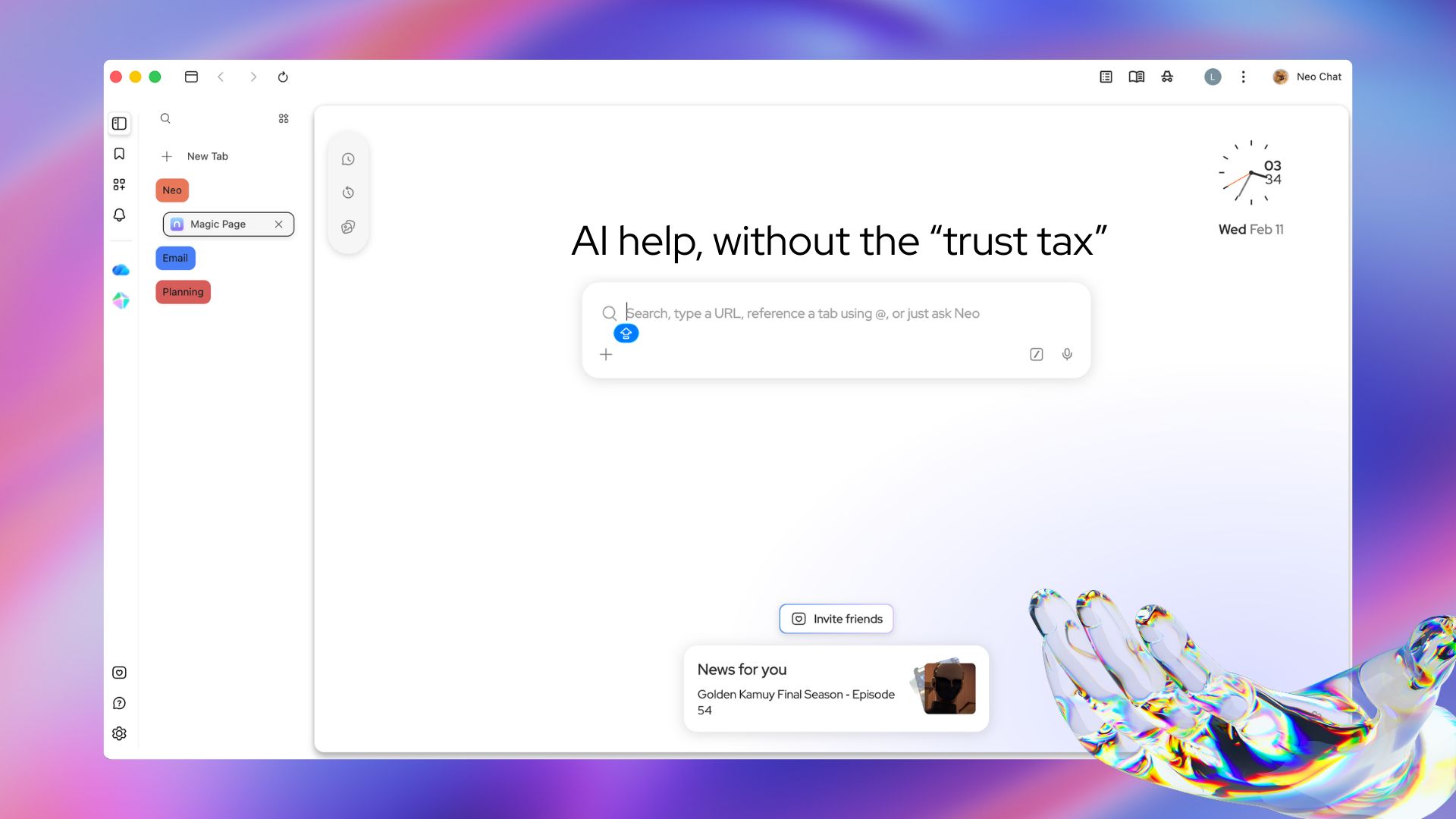
Most AI tools ask you to trade your data for intelligence. Norton Neo doesn't. It's the first safe AI-native browser built by Norton, and it gives you powerful built-in AI without handing your privacy over to get it. Search, summarize, and write with AI built directly into your browser. Your data stays yours. Your context stays private.
Built-in VPN, anti-fingerprinting, and ad blocking come standard. No add-ons. No setup. No compromises.
Fast. Safe. Intelligent. That's Neo.
Stay productive, stay curious—see you next week with more AI breakthroughs!