- Do More Newsletter
- Posts
- Do More Newsletter
Do More Newsletter
This issue contains featured article "How AI Is Turning Us All Into Managers" and exciting new product information about Gusto Cofounder an AI Teammate Built for Small Business, Grammarly Expands Into AI-Powered Productivity Workflows, Anuma Brings Private Memory to Consumer AI, Optimove AI Targets Marketing Teams With AI Everywhere, and Merlin AI Custom Agents Expand Marketing Automation.
In partnership with

Keep up to date on the latest products, workflows, apps and models so that you can excel at your work. Curated by Duet.

Stay ahead with the most recent breakthroughs—here’s what’s new and making waves in AI-powered productivity:
Small business owners wear a lot of hats—HR manager, payroll administrator, recruiter, compliance officer, and often chief problem solver. This week, Gusto introduced Cofounder, an AI teammate designed specifically for small businesses. Unlike generic AI assistants that start with little knowledge about a company, Cofounder can understand information already available through Gusto, including payroll schedules, employee information, benefits administration, and compliance requirements. It can help answer operational questions, surface important business insights, and automate routine administrative work. For entrepreneurs who don't have large support teams, the idea of an AI assistant that already understands the fundamentals of their business is particularly compelling. This launch reflects a growing shift toward specialized AI tools built for real-world business operations rather than general-purpose chatbots.
Grammarly is continuing its evolution from a writing assistant into a broader AI productivity platform with new workflow-focused capabilities designed to help users summarize information, draft content, organize communications, and complete everyday work tasks across the applications they already use. Rather than requiring users to switch between multiple AI tools, Grammarly aims to bring AI assistance directly into email, documents, messaging platforms, and business workflows. For consumers and small businesses, the new features offer a practical way to reduce time spent on repetitive administrative work while improving productivity and communication. As organizations increasingly look for AI tools that integrate seamlessly into existing workflows, Grammarly's latest expansion highlights the growing trend toward embedded AI assistants that help users get more done without changing how they work.
Anuma provides users with a personal AI memory layer that works across multiple AI models and applications while remaining under user control. The platform emphasizes encrypted memory, user ownership of data, and portability across AI ecosystems. For everyday users juggling multiple AI assistants, the concept of a single private memory that follows them from tool to tool will become increasingly valuable as AI becomes more integrated into daily life.
Marketing automation took a major step forward with the launch of Optimove AI. The platform allows marketers to access customer data, campaign analytics, and execution tools directly through AI interfaces including ChatGPT and Claude. Instead of jumping between dashboards, marketers can ask questions in natural language and generate audience segments, campaign ideas, and personalized content. Small businesses with limited marketing resources may find this particularly attractive because it lowers the technical barrier to sophisticated customer engagement strategies.
MoEngage launched Merlin AI Custom Agents, enabling marketers to create AI agents that operate within user-defined rules and workflows. What makes this launch noteworthy is the emphasis on transparency and control. Businesses can see how agents make decisions, define guardrails, and connect those agents with external AI systems such as ChatGPT and Claude through Model Context Protocol (MCP) integrations. For growing businesses looking to automate repetitive marketing tasks without losing oversight, Merlin represents a practical step toward trustworthy AI-driven operations.

Creating professional video content has become one of the most effective ways for businesses and creators to reach audiences, but producing high-quality videos can still require significant time and technical expertise. Captions announced new AI-powered creator tools designed to streamline video production, editing, and content localization. The company continues to expand its platform beyond basic editing by introducing capabilities that help users generate, edit, and optimize videos using AI-assisted workflows.
One of the most interesting aspects of the latest release is the platform's ability to help creators produce content more efficiently for multiple channels. Features such as AI-generated edits, automatic captioning, language translation, and content repurposing allow users to create more content without dramatically increasing production time. For small businesses trying to maintain an active presence on social media, these types of automation tools can provide meaningful time savings.
The growing popularity of short-form video on platforms such as TikTok, Instagram Reels, and YouTube Shorts has increased demand for tools that can accelerate content creation while maintaining quality. Captions is positioning itself as an end-to-end AI production platform that helps creators and marketers keep pace with those demands.
For entrepreneurs, creators, and marketing teams, the appeal is straightforward, spend less time editing and more time publishing.
How AI Is Turning Us All Into Managers

When AI started out, it was a nice little advisor, but increasingly, it can do entire tasks itself. Especially as AI evolves into agents that can check their own work and iterate, you can send it to do things like whole coding tasks on its own where it can even test its results before getting back to you.
So if AI is completing whole tasks on its own, where does that leave you? Are you even needed?
I guess that's the good news: You've been promoted. Now you're a manager.
Suddenly, You're the Boss
For most of the history of work, there were two kinds of jobs: people who did things, and people who oversaw the people who did things. We called the first one labor and the second one management.
That dividing line is quietly dissolving.
If you use an AI agent to draft an email, plan a trip, do research, write a chunk of code, edit a video, or build a spreadsheet — you are no longer doing that work. You are delegating it. And then you are reviewing it. And then you are editing it. And then you are deciding whether it's good enough to ship.
That is a manager's job description. You are now the manager of a very strange employee who can do almost anything moderately well, never gets tired, never gets defensive, occasionally makes up a date, and works for ten dollars a month.
You did not apply for this promotion.
The Skills Nobody Trained You For
The thing is, being a good manager is hard. People go to business school for it. They take classes. They read books with titles like The Making of a Manager and Radical Candor. And those books exist because most people, when given other people to oversee, are not naturally good at it.
The skills you suddenly need turn out to be the ones managers have always needed:
— Taste. Knowing what good looks like, even when you can't quite describe it. The AI will give you ten outputs. You have to know which one is right.
— Briefing. Saying clearly what you want, what you don't want, and what "done" looks like. The AI is a literalist. So, it turns out, is most early-career talent.
— Knowing when to step in. Sometimes the right move is to keep redirecting. Sometimes the right move is to just do it yourself. That second instinct is the one that takes years to develop.
— Trust calibration. Some things the AI does, you can ship without reading. Some things you absolutely cannot. Figuring out which is which is a skill you'll be developing for the rest of your life.
— Caring enough to check. This is the underrated one. Bad managers don't read the work. Good ones do.
Nobody handed you a manual on any of this. You learned to use ChatGPT and somehow ended up running a one-person agency.
Five Things You Started, Zero Things You Finished
Here's the part of being a manager-of-AI that nobody put in the brochure.
When you can delegate one thing, you can delegate ten. So you do.
I'll start an AI on a coding task in one window. Kick off a second one on a different feature. Open a third tab to have an AI dig up some research while those run. Glance at email. Look back. The first one's done — but I no longer remember exactly what I asked it for, or what "good" looked like. So I read it. I reconstruct what I was thinking forty minutes ago. I redirect. Now the second one finishes. I have to reload the context for that one too.
This wasn't a problem when you were just doing one thing. You held the thread because you were in it.
It's a giant problem now.
A human teammate carries their own context. They remember what you asked. They remember what they were doing. They know what "done" means because they've been thinking about it the whole time you weren't.
An AI carries the context just fine. You, however, have to carry the context for yourself — for every parallel thing you delegated. Every check-in is a memory reload. Every approval is a tiny act of reconstruction. Wait, what was I trying to accomplish here? Is this what I wanted? Why did I think this was a good direction?
By the time you've reviewed all five things, the day is over and you have shipped, in some real sense, zero of them.
The promise of AI was that it would free up your attention. The reality, for a lot of us, is that it multiplies the number of things demanding it.
The fix isn't to stop delegating. The fix is to be much more careful about how many open loops you keep at once. Two might be the magic number. Three is risky. Five is a guarantee that nothing gets your full judgment — which is exactly the input the AI most needs from you.
The hardest part of being a manager turns out to be the part nobody talks about: deciding what not to start.
The Skills You're Quietly Losing
Here's the part nobody likes talking about.
Faculties you don't use, you lose. Anybody who's stopped writing by hand can feel it — your handwriting now looks like a child's. Anybody who's stopped doing math on paper can feel it too. The neural pathway is still there. It's just dusty.
When you delegate every piece of writing to an AI, the thinking that used to happen while you wrote — the working-out, the second-guessing, the discovering-what-you-meant-by-saying-it — stops happening. You get the output. You don't get the thought.
Same with research. Same with planning. Same with coding. You're getting the answer; you're not building the understanding.
Now — that's not categorically bad. We made the same trade with calculators. We made it with search engines. Most of us cannot do long division anymore, and we are mostly fine. The trade was worth it.
But the trade is real, and it's worth being honest about. The version of you that has used AI as the default tool for ten years will be a different person than the version of you that mostly did the work by hand. Sharper at some things. Duller at others. Faster, almost certainly. Better? That's an open question, and the answer is going to be different for each of us.
The Strange New Question: Was It a Good Day?
There used to be a simple way to know whether you'd had a good day at work. You looked at what you made. You knew you had made it. The thing in front of you was evidence that the day had not been wasted.
What is that now?
If a manager spends the day reviewing five things that other people made, did they have a productive day? Yes, sort of, in a balance-sheet sense. But there's a famous restlessness to management — the reason people who get promoted out of doing the work often miss the work — that has to do with this exact thing. You stop being the person who made the thing. You become the person who approved the thing.
A lot of us are now going to spend a lot of our day approving things. Five drafts before lunch. Three spreadsheets after. A slide deck you'd never have written yourself. A code review for code you didn't write.
The output of the day looks bigger than it ever has. The satisfaction of the day — for some of us — is going to feel smaller than it ever has.
That's not a reason to stop. The trade is, again, probably worth it. But it's worth noticing we're trading.
A good manager finds satisfaction in a different place: in the work the team produced together, in the people they helped get better, in the calls they made that turned out to be right. There's real meaning there. It's just learned, not given.
The rest of us are about to do that learning, all at once, on the job.
One Small Recommendation
Stay close enough to the work to know if it's good.
That's it. That's the whole thing.
If you delegate everything, you eventually can't tell whether what comes back is any good. And then you're not a manager. You're a forwarder.
The good managers I've known share one trait: they could always still do the work themselves. They didn't, because their time was better spent elsewhere. But they could. And the people working for them knew it. And the work was better for it.
Whatever AI ends up doing for you over the next ten years, try to stay in that condition. Use it. Delegate to it. Move faster. But also — sometimes — sit down and write the thing yourself. Do the math on paper. Cook without the recipe. Plan the trip the old way.
Not because the old way is better.
Because you are better when you remember how.

Partner Spotlight: Periscope VPN by Duet Display
Periscope by Duet Display is designed to provide secure, private internet access for professionals, remote workers, travelers, and anyone concerned about online privacy. The service is easy to set up, allowing users to get connected quickly without complicated configuration.
Periscope emphasizes security with state-of-the-art end-to-end encryption, a strong commitment to user privacy, and an absolutely no-logging approach. That means your activity isn't stored, tracked, or retained, helping provide an additional layer of protection whether you're working from home, traveling, or connecting through public networks.
For users who want a straightforward privacy solution backed by a focus on security and simplicity, Periscope offers an approachable way to improve online protection while maintaining a smooth browsing experience.
Sign up or learn more at: https://getperiscope.com

Question 1: What is your current roll?If you're currently looking for a job, please select the role that best matches the position you're seeking. |
Question 2: What industry do you work in? |
Fast browsing. Faster thinking.
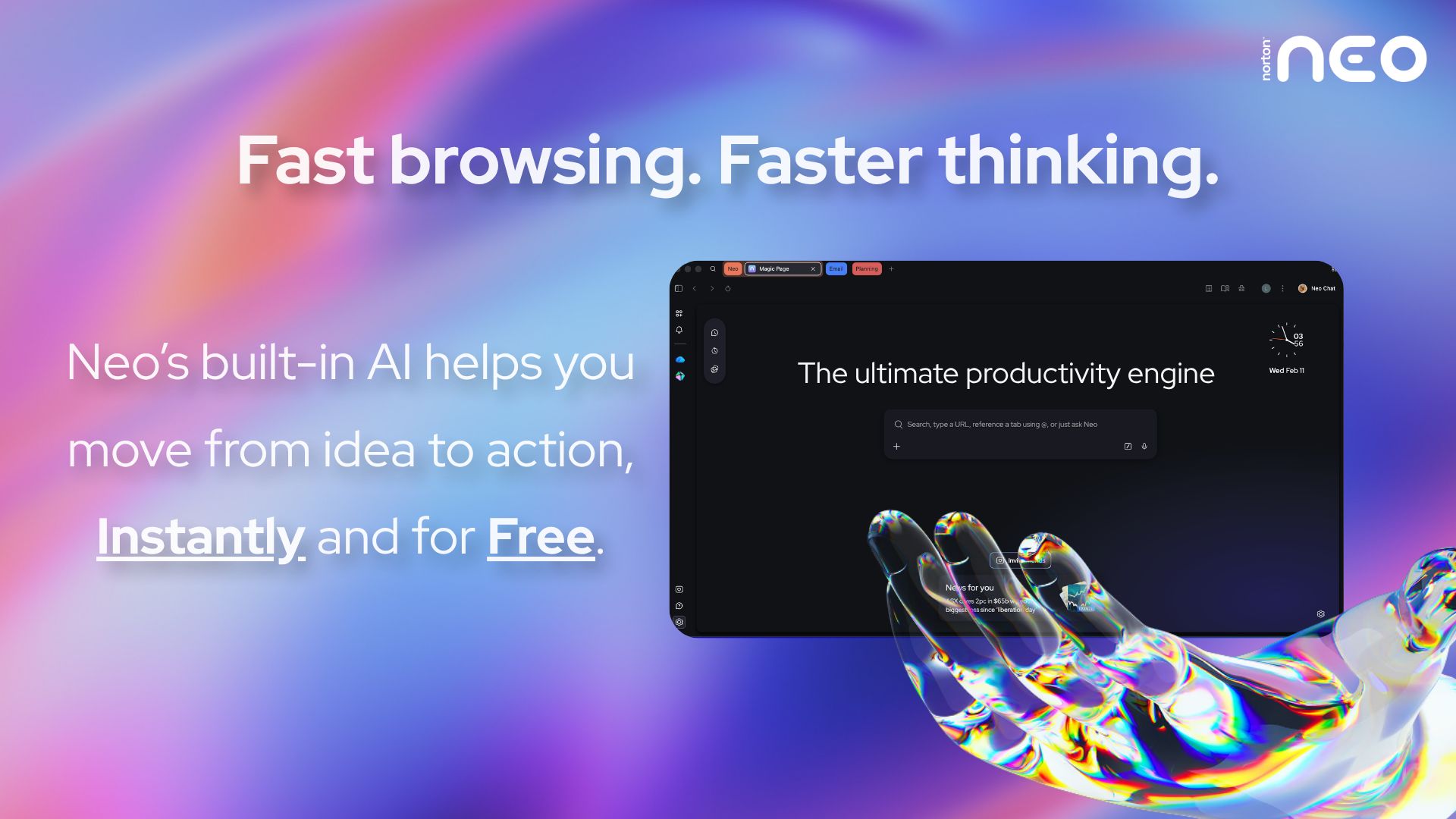
Your browser gets you to a page. Norton Neo gets you to the answer. The first safe AI-native browser built by Norton moves with you from idea to action without slowing you down. Magic Box understands your intent before you finish typing. AI that works inside your flow, not beside it. No prompting. No copy-pasting. No switching apps.
Built-in AI, instantly and for free. Privacy handled by Norton. Built-in VPN and ad blocking protect you by default. No configuration. No extra apps. Nothing to think about.
Fast. Safe. Intelligent. That's Neo.
Stay productive, stay curious—see you next week with more AI breakthroughs!