- Do More Newsletter
- Posts
- Do More Newsletter
Do More Newsletter
This issue contains featured article "Mythbusting: 'AI Took My Job' — How Tasks Shift Before Roles Vanish", and exciting product information about FrenchieGPT.ai, Yahoo 'Your Daily Digest', Google Workspace Study on AI Use By Rising Leaders, Figma AI Editing Tools, and OpenAI GPT-5.2 Model.
In partnership with

Keep up to date on the latest products, workflows, apps and models so that you can excel at your work. Curated by Duet.

Stay ahead with the most recent breakthroughs—here’s what’s new and making waves in AI-powered productivity:
FrenchieGPT.ai – Dog Training & Puppy Care
FrenchieGPT.ai is a newly launched AI-powered mobile app focused on dog training and puppy care, giving pet owners on-demand coaching for behavior issues, house training, and daily routines. The app uses conversational guidance, checklists, and personalized routines to help owners respond consistently to barking, chewing, leash pulling, and crate training challenges, making it easier for busy households to stay aligned on training plans. It also offers health and care tips tailored to a dog’s age and lifestyle, turning fragmented online advice into a single, structured companion for first-time and experienced dog owners alike.
Yahoo “Your Daily Digest” – AI Audio Briefings
Yahoo has rolled out “Your Daily Digest,” a new AI-powered afternoon audio news briefing inside the Yahoo News app, available on weekdays from noon to 5 p.m. local time in the U.S. The feature automatically assembles 6–8 minute audio briefings from topics each user engages with most—like lifestyle, entertainment, and current events—so knowledge workers can stay informed while commuting, exercising, or multitasking. By pairing AI summarization with editorial quality checks, “Your Daily Digest” aims to deliver concise, personalized news updates that fit into small pockets of time throughout the workday, improving information intake without adding screen time.
A recent Google Workspace study highlights growing demand for AI that acts not only as a productivity tool but as a personalized advisor for emerging leaders, informing a new wave of Workspace AI features focused on guidance, coaching, and tailored recommendations. These capabilities are designed to help rising managers prioritize work, refine communication, and navigate career decisions by surfacing context-aware suggestions in documents, email, and collaboration flows. For organizations, this positions Workspace’s AI layer as a development and productivity coach embedded directly in everyday tools, rather than a separate training platform.
Figma has introduced three new AI image editing tools—Erase Object, Isolate Object, and Expand Image—bringing generative image editing closer to professional designers directly within their workflows. These tools allow creators to remove elements, isolate objects, and expand backgrounds without resorting to external graphic editors. This update streamlines visual content creation inside Figma’s interface.
OpenAI has launched GPT-5.2, its latest generative AI model optimized for professional workflows. GPT-5.2 boasts improvements in long-context comprehension, complex task execution, and multimodal capabilities—including spreadsheet automation, presentation generation, code writing, and document interpretation. This upgrade is designed to make AI assistance more effective and reliable across a wide range of tasks for professionals and creators alike.

FrenchieGPT.ai – Turning AI into a Dog-Training Coach
FrenchieGPT.ai is a new AI app built specifically for dog training and puppy care, combining chat-based guidance with structured training programs to support owners through the most demanding stages of pet ownership. Instead of leaving users to sift through long forum threads or generic advice, the app provides concise, situation-specific instructions—such as how to respond when a puppy whines in the crate or how to redirect chewing—along with explanations that reinforce consistent handling. For time-pressed consumers, this creates a just-in-time training companion that fits into daily life without requiring scheduled classes or lengthy reading.
The flagship capability of FrenchieGPT.ai is its AI-guided training flows, which adapt to a dog’s age, behavior patterns, and owner feedback over time. As users log progress or setbacks, the system can adjust routines, recommend new exercises, or escalate to more advanced strategies, effectively acting as a dynamic training plan rather than a static checklist. This personalization reduces guesswork for owners, helping them move from trial-and-error toward a structured, data-informed progression that keeps both dog and human on track.
A key benefit of the new feature set is the way it consolidates health, behavior, and daily care insights into one interface, instead of forcing owners to jump between articles, videos, and social media advice. By centralizing puppy-care tips, warning signs to watch for, and basic wellness guidance, the app can nudge owners toward timely vet visits, consistent feeding and exercise schedules, and preventive habits that reduce stress later on. For many households, especially first-time dog owners, this unified view can translate into fewer avoidable problems and a smoother path from chaotic puppy months to well-adjusted adulthood.
To get the most value from FrenchieGPT.ai, new users benefit from setting clear goals in the app—such as crate training, leash manners, or socialization—so the AI can prioritize the most relevant routines. Regularly updating behavior logs and noting specific problem scenarios allows the system to tune its advice rather than repeating generic tips. Over time, treating the app like a living training journal and coach, rather than a one-off Q&A tool, helps unlock its full potential as a personalized companion for both dog and owner.
Mythbusting: “AI Took My Job” — How Tasks Shift Before Roles Vanish
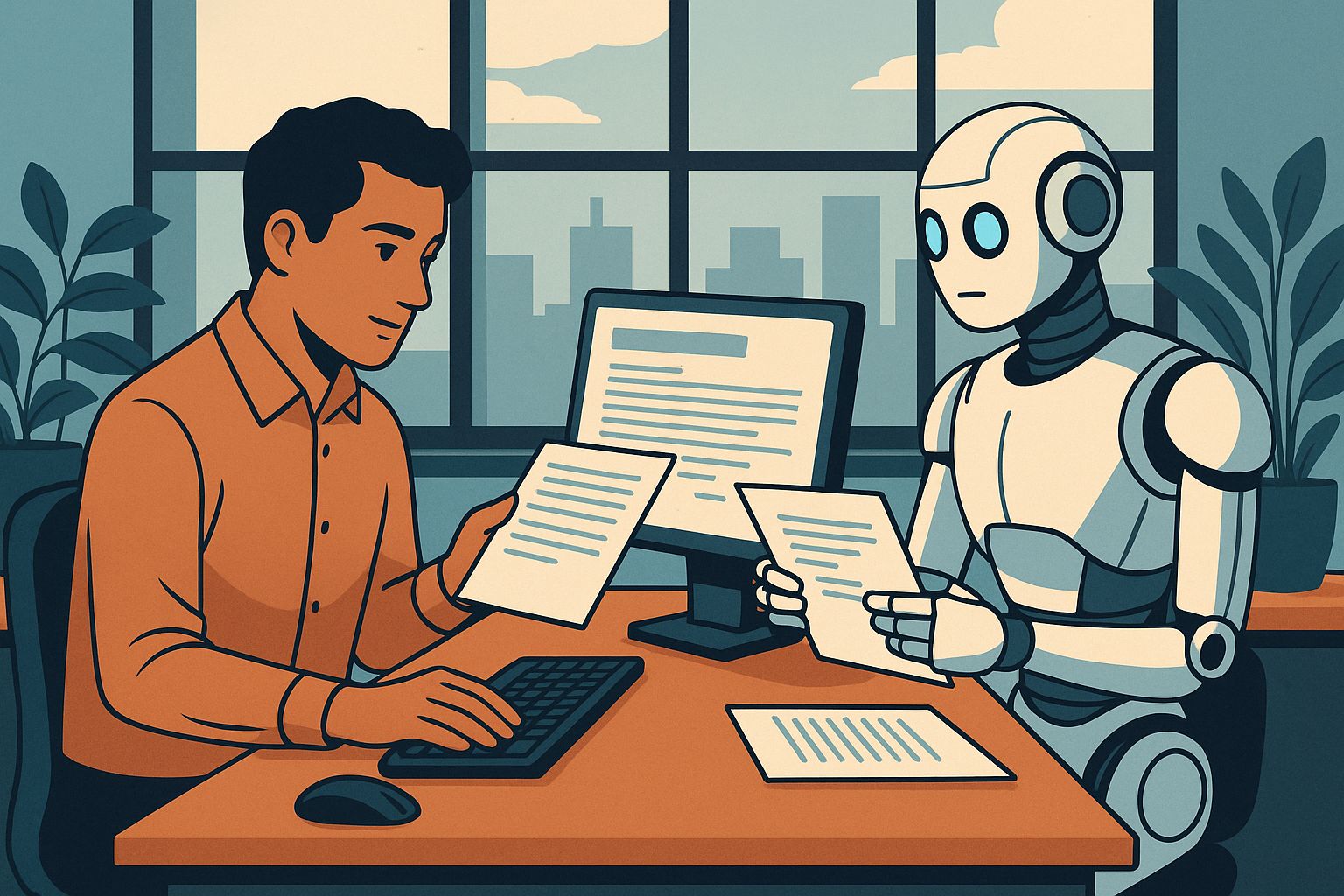
We’re used to machines coming for manual labor, but with AI, machines now seem to be after every white collar job as well. Team Panic thinks this is going to lead to an AI apocalypse in the jobs market, while Team Denial still believes these error-prone machines can’t ever replace humans. Both sides miss the quieter, weirder truth: most of the time, AI doesn’t “take” a whole job so much as it takes a handful of tasks—and then leaves you holding the rest, along with a new set of expectations.
That distinction sounds like semantics until it hits your paycheck. Jobs aren’t single activities; they’re bundles. When AI gets adopted, it usually grabs the repetitive, templated, easy-to-measure parts first (drafting, sorting, routing, summarizing). The role often survives—but it mutates.
Jobs are bundles, not bricks
Think of a job as a mixed plate at a barbecue joint. There’s brisket (hard, slow, craft), mac and cheese (repeatable, standard), and a plastic fork (somehow always flimsy). AI is great at the mac and cheese. It’s getting better at the fork. It still struggles with the brisket.
That’s why the scariest stats are often misunderstood. A November 2025 McKinsey Global Institute analysis estimated that existing technology could, in theory, automate about 57% of current U.S. work hours. That’s “technical potential,” not “next quarter’s layoff plan.” Another common headline—“40% of jobs will be eliminated”—often comes from confusing “jobs with high task exposure” with “jobs that disappear.” Many roles will be redesigned long before they’re removed.
Employers don’t buy “jobs.” They buy outcomes. If AI makes certain tasks cheaper, companies reorganize the work: fewer people do the routine parts; more people do exception-handling, customer work, oversight, sales, maintenance, and troubleshooting. Sometimes that means fewer total workers. Sometimes it means the same number doing different things. Sometimes it means more workers because the service gets cheaper and demand rises.
History doesn’t repeat, but it does rhyme
We’ve seen this “tasks shift before roles vanish” movie before. ATMs replaced a chunk of what bank tellers did—cash dispensing, basic transactions—so banks needed fewer tellers per branch. But ATMs also made branches cheaper to operate, so banks opened more branches. The result was not “tellers extinct,” but “tellers do different work,” like customer service and sales; some analyses note teller employment actually rose for decades even as ATMs spread.
Economist David Autor’s broader point is that automation usually substitutes for some labor while complementing other labor, raising output and creating new demand in the process. That’s why “this tool can do X% of tasks” doesn’t automatically translate to “X% of people are fired.”
What the labor-market data says (late 2025 edition)
First, the good news for doomscrollers: there’s no clean evidence of an across-the-board “AI jobs apocalypse” yet. Brookings researchers looking at data in 2025 described “stability, not disruption—for now,” while warning the pace could change quickly.
Second, the bad news for complacency: there is evidence of real displacement, especially at the entry level. A Stanford Digital Economy Lab analysis using high-frequency payroll data found that early-career workers (ages 22–25) in the most AI-exposed occupations saw a 13% relative decline in employment after the widespread adoption of generative AI, even after controlling for firm-level shocks.
Third, the complicated news: AI can raise productivity and wages in the sectors using it, even while it reshuffles who gets hired. PwC’s 2025 Global AI Jobs Barometer reports faster revenue growth per employee in more AI-exposed industries and faster wage growth there as well. It also reports a rising wage premium for jobs that require AI skills.
Zooming out, the World Economic Forum’s Future of Jobs Report 2025 expects big churn through 2030—170 million new roles created, 92 million displaced, net +78 million—driven by technology, demographics, and geopolitics. That’s not comfort; it’s a weather report: pack layers.
And the U.S. Bureau of Labor Statistics has started incorporating AI into its projections by focusing on which occupations have “core tasks” that current generative AI can replicate most easily—again, a task-level lens, not a “this job is gone” stamp.
Rule of thumb: if your work is digital and text-heavy, AI reshapes it faster; if it’s physical and people-heavy, slower, generally.
So if AI isn’t (yet) a universal job vacuum, what is it? Mostly, it’s a task reallocator. Here’s what that feels like in real work.
White-collar work: AI as intern, editor, and occasional liability
Start with the office. Generative AI is very good at producing “first drafts”: emails, meeting notes, slide outlines, boilerplate analyses. It’s also very good at sounding confident while being wrong. The early, painful reminder came in journalism: CNET used AI tools to generate personal finance explainers and later issued corrections on 41 of 77 AI-written stories. The lesson wasn’t “never use AI.” It was “you still need humans for accuracy and judgment.”
Law is a clean example of task shift. AI can summarize case law, scan documents, and draft contract language quickly. But law isn’t just text production; it’s risk, strategy, and accountability. The BLS projects lawyers to grow about 4% from 2024–2034, while paralegals and legal assistants are projected to show little or no change overall (0%). That’s a hint that routine support tasks may be where efficiency shows up first, even if the profession remains.
Finance and insurance show a similar pattern. Claims teams increasingly use software and automated tools to speed routine cases, with humans focusing on complex claims, negotiations, and customer communication. The BLS projects claims adjusters, appraisers, examiners, and investigators to decline about 5% from 2024–2034—even while projecting about 21,600 openings per year due to retirements and job switching. Translation: fewer seats, but not an empty theater.
Software development is the poster child for “task shift before role shift.” In the 2025 Stack Overflow Developer Survey, 84% of respondents say they’re using or planning to use AI tools in their development process, and 51% of professional developers report daily use. AI helps with routine code, tests, and documentation; humans still own architecture, integration, and the hard parts of “What should we build, and what could go wrong?”
Customer service is another fast-moving front. IBM notes that AI customer service chatbots can reduce operational costs and handle routine inquiries quickly, while humans handle escalations, empathy, and messy edge cases. The “AI took my job” version is a call center vanishing; the reality is often fewer agents doing repetitive scripts and more agents doing complex problem-solving—plus people training, monitoring, and auditing the systems.
Blue-collar work: robots take tasks, humans take responsibility
In the physical economy, the bottleneck is less “Can the AI write a paragraph?” and more “Can a machine operate safely in an unpredictable world?” That’s why task automation shows up first as robots doing predictable movements in controlled environments—warehouses and factories—while humans still handle variability, maintenance, and oversight.
Amazon is an extreme but useful case study. The company says it has more than 1 million robots working in its operations, while 2025 reporting described its robotic workforce nearing the size of its human staff (roughly 1.5+ million employees). The big change is not “humans replaced.” It’s the mix of tasks: fewer miles walked, more time managing systems, fixing jams, maintaining equipment, and doing the tricky parts robots still struggle with.
Transportation is where predictions often sprint ahead of reality. Fully autonomous driving at scale is hard: safety, regulation, weather, odd human behavior, and the fact that roads are not a lab. That doesn’t mean drivers are safe forever, but it does suggest the transition will come in stages—driver-assist features, limited-route autonomy, remote monitoring—long before “no drivers at all.”
Construction and the skilled trades are similarly resistant to full automation because job sites are chaos. AI can help with planning, scheduling, estimating, and inspection (think drones and computer vision). But the person who figures out how to make the crooked wall meet the not-quite-square door frame is still in demand. In practice, many “AI in construction” gains look like fewer mistakes, better scheduling, and faster paperwork—not a robot framing your house.
Creative work: AI as power tool (and awkward collaborator)
If you were promised “creative jobs will be safe,” you deserve a refund. Generative AI can produce images, music, scripts, and drafts on demand. But what it mostly automates is a set of tasks—variations, mockups, rough drafts—not the whole craft of taste, storytelling, and knowing what a client means when they say “make it pop.”
A 2025 overview reported that generative AI could automate up to about 26% of tasks in arts, design, entertainment, media, and sports, and pointed to surveys where roughly three-quarters of creative professionals find AI useful for things like image editing and research. That reads less like replacement and more like the arrival of a new tool everyone argues about in Slack.
There’s also a social layer: some people use AI openly; others “AI creep,” quietly relying on it while worrying colleagues will judge them. A Business Insider report on “AI creeping” described stigma around AI use even as many creatives said it boosts productivity. Work doesn’t just change technically; it changes culturally.
The uncomfortable myth-busting part: yes, some roles will shrink
Here’s what many “don’t worry about it” takes skip: sometimes the bundle gets small enough that the role really does disappear—or gets consolidated into fewer jobs.
Routine, rules-based, highly standardized work is most exposed. Think basic data entry, simple bookkeeping, scheduling, first-line customer support scripts, and some kinds of junior content production. When AI can do 60% of a job cheaply and “good enough,” companies may decide one experienced person plus a tool can replace two junior hires. That’s one reason early-career workers show up in displacement data.
Also, don’t ignore timing. Even if new jobs are created in the long run, transitions happen to real people on real schedules. A “net gain” can still include painful local losses, especially where retraining is slow or where new jobs aren’t nearby.
How to stay employable in the age of task shift
The safest bet isn’t picking a “safe job.” It’s building “safe leverage.”
Get close to the messy parts. AI loves clean inputs and predictable outputs. Humans still dominate ambiguity: diagnosing the real problem, dealing with edge cases, negotiating trade-offs, managing stakeholders, calming upset customers, and making judgment calls.
Become the person who can check the machine. As AI-generated content spreads, verification becomes valuable. Editors, reviewers, auditors, quality leads, security-minded engineers—these roles matter more when first drafts are cheap.
Learn the tools, but don’t worship them. In many fields, the baseline expectation will become “You can use AI competently,” the way “you can use spreadsheets” became assumed. Tool fluency is table stakes; judgment is the differentiator.
Invest in human skills that scale. Communication, persuasion, leadership, teaching, and domain expertise travel across tools. The model changes; the need to explain, sell, and decide doesn’t.
Protect the entry-level ladder. If AI eats the junior tasks, you need new ways to develop talent—or you’ll wake up in five years with nobody who knows how the job works.
Conclusion: the headline should be “AI Took My Tasks”
The cleanest mythbust is this: most people who say “AI took my job” are really saying “the tasks I used to do—especially the easy-to-measure ones—got automated, and my role didn’t adapt fast enough.”
That’s not a minor distinction. It changes what we prepare for. Instead of imagining a world where jobs suddenly vanish, picture a world where every job becomes a moving target—more tool-driven, more oversight-heavy, more focused on the parts machines don’t handle well.
AI will eliminate some roles over time. It will also create others. But the main action right now is task shift: the slow, relentless rearranging of what “a normal day at work” looks like. If we treat that as the default, we can stop arguing about whether the robots are coming and start building careers (and companies) that can change faster than the tools do.

Partner Spotlight: Duet Display
Duet Display turns an iPad, Mac, Windows PC, Chromebook, and Android devices into a high-performance second display or remote desktop for your main computer, helping professionals and creators reclaim screen real estate. The app is optimized for low-latency wired and wireless connections, making it suitable for multitasking, live editing, design, and productivity enhancing workflows across home, office, and travel setups. Learn more and explore at Duet Display.
The Future of Shopping? AI + Actual Humans.

AI has changed how consumers shop by speeding up research. But one thing hasn’t changed: shoppers still trust people more than AI.
Levanta’s new Affiliate 3.0 Consumer Report reveals a major shift in how shoppers blend AI tools with human influence. Consumers use AI to explore options, but when it comes time to buy, they still turn to creators, communities, and real experiences to validate their decisions.
The data shows:
Only 10% of shoppers buy through AI-recommended links
87% discover products through creators, blogs, or communities they trust
Human sources like reviews and creators rank higher in trust than AI recommendations
The most effective brands are combining AI discovery with authentic human influence to drive measurable conversions.
Affiliate marketing isn’t being replaced by AI, it’s being amplified by it.
Stay productive, stay curious—see you next week with more AI breakthroughs!